Engineering resumes face a unique challenge that most other professions do not: the tools, languages, and frameworks you list matter as much as your accomplishments. A recruiter scanning for a backend role might configure their ATS to filter specifically for "Kubernetes," "Go," or "PostgreSQL." If your resume says "container orchestration" instead of "Kubernetes," or "SQL databases" instead of "PostgreSQL," you may never make it past the first screen.
The problem is compounded by how fast the engineering landscape moves. A tech stack that was cutting-edge three years ago might now be considered legacy. Different companies use different names for the same tools, and different roles within engineering -- frontend, backend, DevOps, data, ML -- each have entirely separate keyword vocabularies. This guide walks you through how to structure your engineering resume so it speaks the exact language that both ATS filters and technical recruiters are looking for. You can also run an ATS compatibility check first, since a multi-column layout can hide your stack from the parser entirely.
Write a Headline That Highlights Your Stack
Your resume headline is the single most scanned line on the page. In engineering, it needs to do three things at once: state your role clearly, name your core technologies, and give the recruiter a reason to keep reading. A vague headline forces the recruiter to dig through your resume for basic information, and most will not bother.
STRONG EXAMPLE
"Senior Software Engineer | Python, AWS, Kubernetes | 8 Years Building Scalable Distributed Systems"
WEAK EXAMPLE
"Software Engineer with Experience in Various Technologies"
The strong example leads with the seniority level, names three key technologies an ATS can match against, and quantifies experience with a specific focus area. The weak example tells the recruiter nothing about your specialization, your tech stack, or your level -- three things every engineering job description specifies.
Write a Summary That Proves Your Impact
Your summary should go beyond listing technologies. It needs to connect your technical skills to measurable business outcomes. Engineering hiring managers want to see that you understand how your code, your architecture decisions, and your infrastructure work translate into real value -- faster deployments, reduced costs, improved reliability, or better user experience.
STRONG EXAMPLE
"Backend engineer with 6 years of experience designing microservices in Python and Go on AWS. Led migration from monolith to event-driven architecture serving 2M+ daily active users, reducing API latency by 40% and infrastructure costs by $180K annually. Experienced with Kubernetes, Terraform, PostgreSQL, and CI/CD pipelines using GitHub Actions. Looking to bring distributed systems expertise to a senior backend role at a growth-stage company."
WEAK EXAMPLE
"Passionate software engineer who loves building things. Proficient in many programming languages and frameworks. Team player who is always eager to learn new technologies."
The strong example names specific technologies, quantifies the scale of the systems involved, and shows measurable business impact. The weak example could describe any engineer at any level. Words like "passionate," "many," and "eager to learn" carry zero weight with ATS filters and give hiring managers nothing concrete to evaluate.
See If Your Tech Stack Matches the Job
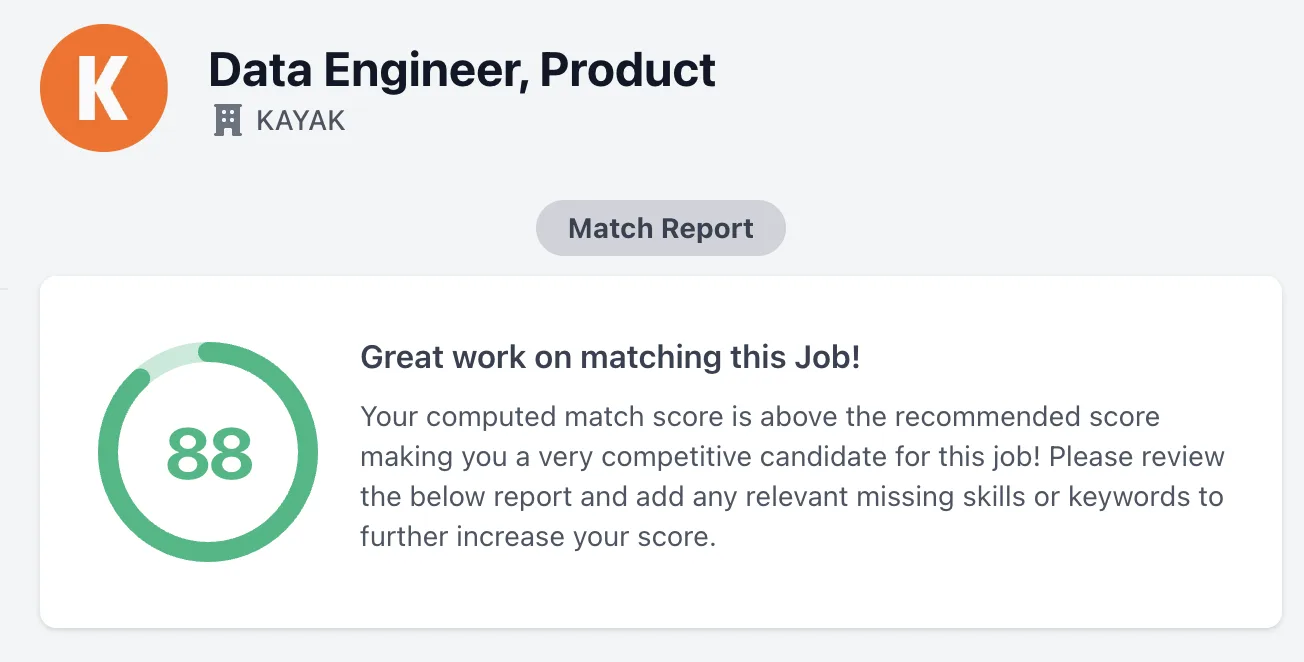
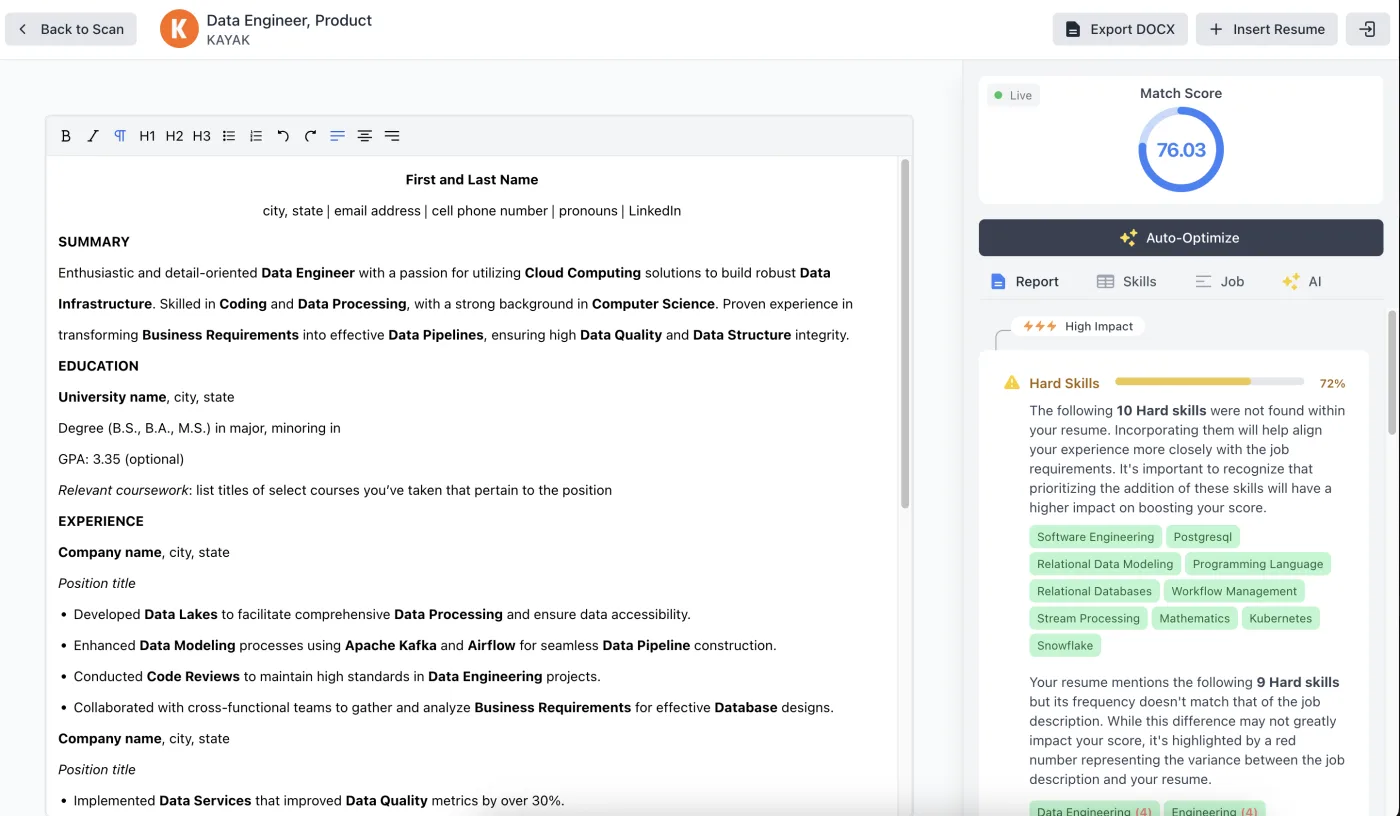
Upload your engineering resume and a job description to instantly see which keywords from the posting are missing from your resume.
Scan My Resume
Listing Your Tech Stack
Your technical skills section is one of the most important parts of an engineering resume. ATS systems parse this section heavily, and recruiters often scan it before reading anything else. How you organize and present your tech stack can be the difference between a callback and a rejection.
Group by Category
Never present your skills as a single wall of comma-separated terms. Instead, group them into logical categories that mirror how engineering teams think about their tooling. Common groupings include Languages, Frameworks & Libraries, Cloud & Infrastructure, Databases, and Tools & Platforms. This structure makes it easy for both humans and ATS parsers to find what they are looking for.
Order by Relevance
Within each category, list your strongest and most relevant skills first. If the job description calls for React and TypeScript, those should appear before jQuery or CoffeeScript. The first two or three items in each category get the most visual attention, so use that real estate wisely. Scan the target job description and mirror its priority order whenever possible.
When to Include Version Numbers
Include version numbers only when the job description specifies them or when the version represents a fundamentally different skill set. For example, "Python 3" versus "Python 2" matters because of significant language differences. "React 18" might matter if the posting mentions it. But adding version numbers to every tool clutters your resume and makes it harder for ATS systems to match keywords. When in doubt, leave version numbers out.
Proficiency Levels: Use With Caution
Avoid rating your skills with bars, stars, or percentages -- ATS systems cannot parse visual elements, and there is no universal standard for what "4 out of 5 stars in Python" means. If you want to indicate proficiency, use your experience section to demonstrate it through accomplishments. If a role asks for "proficiency in Kubernetes," the fact that you deployed and managed production clusters across 3 environments says more than any self-rating ever could.
STRONG EXAMPLE
Languages: Python, TypeScript, Go, SQL
Frameworks & Libraries: React, Node.js, Django, FastAPI
Cloud & Infrastructure: AWS (EC2, Lambda, S3, RDS), Terraform, Docker, Kubernetes
Databases: PostgreSQL, Redis, MongoDB, Elasticsearch
Tools & Platforms: Git, GitHub Actions, Jenkins, Datadog, Jira
WEAK EXAMPLE
Python, JavaScript, TypeScript, HTML, CSS, React, Angular, Vue, Node.js, Express, Django, Flask, FastAPI, Java, C++, Go, Rust, Ruby, PHP, Swift, Kotlin, AWS, GCP, Azure, Docker, Kubernetes, Terraform, Ansible, Jenkins, CircleCI, GitHub Actions, Travis CI, PostgreSQL, MySQL, MongoDB, Redis, Cassandra, DynamoDB, Elasticsearch, Kafka, RabbitMQ, GraphQL, REST, gRPC, Git, Linux, Nginx, Apache, Datadog, Splunk, Grafana, Prometheus, Jira, Confluence
The strong example groups skills logically and lists a focused, believable set of technologies. The weak example dumps fifty-plus tools into a single block with no structure. Recruiters and ATS systems struggle to extract meaning from this kind of list, and hiring managers will question whether you actually have depth in any of them. If your skills section reads like a technology encyclopedia, it signals breadth without depth -- the opposite of what most engineering roles require.
TIP
Tailor your tech stack section to each application. Paste the job description into SkillSyncer alongside your resume and it will show you exactly which technologies from the posting are missing from your resume. Add the ones you genuinely know, and remove the ones that are irrelevant to the role. A focused list of 15-20 technologies beats a generic list of 50 every time.
Don't Miss a Single Technical Keyword
SkillSyncer compares your resume to the job description and shows you which technical keywords, tools, and frameworks from the posting are missing.
Try It Free
Key Skills for Engineering Resumes
These are among the most commonly searched keywords in engineering job descriptions. Include the ones that genuinely match your experience and that appear in the specific roles you are targeting.
Python
JavaScript
TypeScript
React
Node.js
AWS
Docker
Kubernetes
CI/CD
Git
SQL
NoSQL
REST APIs
Microservices
Agile/Scrum
System Design
Machine Learning
Cloud Architecture
DevOps
Linux
Do not copy this entire list into your resume. Instead, scan your resume against each job posting with SkillSyncer to see which specific keywords that employer is filtering for, then incorporate the ones that honestly reflect your experience.
Common Mistakes on Engineering Resumes
1. Listing every technology you have ever touched. Including fifty technologies on your resume does not make you look versatile -- it makes hiring managers question your depth. If your skills section includes Angular, React, Vue, Svelte, jQuery, Backbone, and Ember, a recruiter will assume you are a generalist without real expertise in any of them. Focus on the 15-20 technologies you can speak to confidently in an interview, and prioritize the ones that match the job description.
2. No metrics on your engineering impact. "Built a REST API" tells the hiring manager what you did. "Built a REST API serving 50K requests per second that reduced data retrieval latency by 65%" tells them why it mattered. Engineering managers care about scale, performance, reliability, and cost savings. Every bullet point on your resume should include at least one number whenever possible: users served, latency reduced, uptime achieved, deployment frequency increased, or dollars saved.
3. Ignoring soft skills like collaboration and communication. Engineering does not happen in a vacuum. Job descriptions for senior and staff-level roles almost always mention cross-functional collaboration, mentorship, code review, and stakeholder communication. If your resume reads like a list of solo side projects, you are missing keywords that ATS systems are configured to find. Include bullet points that demonstrate how you worked with product managers, mentored junior engineers, or led architecture discussions.
4. Not matching the exact tool names from the job description. ATS systems match keywords literally. If the job posting says "Amazon Web Services" and your resume only says "AWS," some systems will miss it. If the posting says "React.js" and you wrote "React," you might lose a match. The safest approach is to include both the full name and the abbreviation the first time you mention a tool: "Amazon Web Services (AWS)" or "Kubernetes (K8s)." Scan your resume with SkillSyncer against the specific job description to catch these mismatches before you submit.