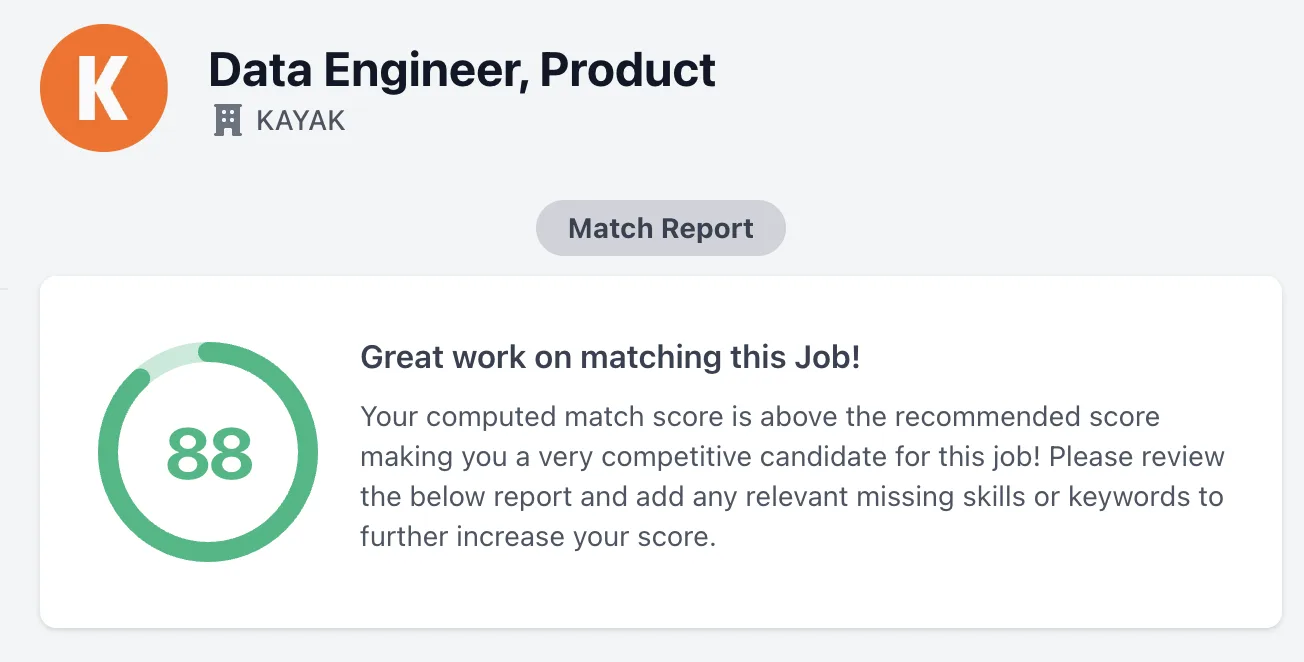
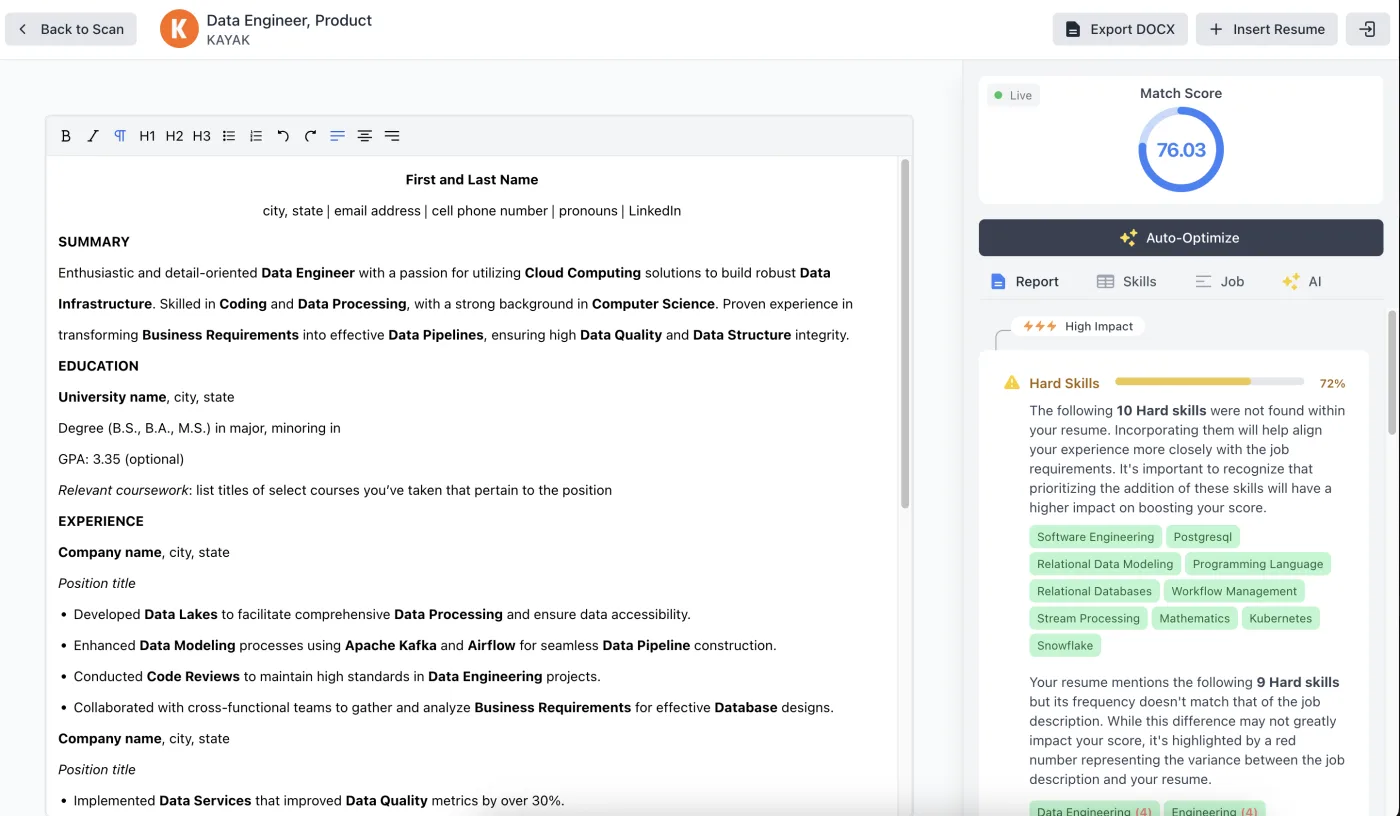
As a student or recent graduate, you face a frustrating catch-22: employers want experience, but you need a job to get experience. To make things harder, you are competing against candidates who have years of professional history on their resumes. And before a human recruiter ever reads your application, it has to pass through an Applicant Tracking System that is scanning for specific keywords and qualifications.
The good news is that you have more relevant experience than you think. Coursework, group projects, internships, volunteer work, part-time jobs, and campus organizations all contain transferable skills that employers value. This guide will show you how to surface those skills, structure your resume for ATS compatibility, and present yourself as a strong candidate even without a traditional work history. When you have a draft, test your resume for ATS compatibility to confirm it parses cleanly.
Free Premium for Students
SkillSyncer offers free premium access to active students. Sign up with your .edu email address for instant activation, or email support@skillsyncer.com with proof of enrollment and we will upgrade your account. The same year is open to veterans and military spouses, on the military program page.
Write a Resume Headline That Stands Out
Your headline is the first line a recruiter reads after your name, and it sets the tone for your entire resume. Many students leave this blank or write something generic like "Hard Worker." Instead, use this space to communicate your degree, your area of focus, and one or two concrete qualifications. Think of it as a search result for yourself: if a recruiter searched for the ideal entry-level candidate, would your headline match?
STRONG EXAMPLE
"B.S. in Marketing, 2026 | Social Media Strategy & Data Analytics | Google Analytics Certified"
WEAK EXAMPLE
"College Student Looking for Entry-Level Job"
STRONG EXAMPLE
"Recent Computer Science Graduate | Full-Stack Web Development & Python | 3 Completed Capstone Projects"
WEAK EXAMPLE
"Motivated Self-Starter Seeking Opportunities"
The strong examples lead with a specific credential, name a skill area, and include a quantifiable detail. The weak examples could apply to anyone and give the recruiter no reason to keep reading. When an ATS scans your headline, generic phrases like "hard worker" will never match a job description keyword. Specific terms like "Data Analytics" and "Python" will.
Write a Summary That Shows Your Value
The summary section is where most student resumes fall apart. Students tend to write objective statements that focus on what they want ("Seeking a position where I can learn and grow") rather than what they offer. Hiring managers do not care what you want. They care what you can do for them. Flip the perspective: lead with your strongest qualifications, mention a relevant accomplishment, and name the type of role you are targeting.
STRONG EXAMPLE
"Detail-oriented Finance graduate (GPA: 3.7) with hands-on experience in financial modeling and data analysis through two internships and a university-led investment fund managing $50K in assets. Proficient in Excel, Bloomberg Terminal, and SQL. Seeking an entry-level financial analyst role where I can apply quantitative analysis skills to support data-driven business decisions."
WEAK EXAMPLE
"Recent graduate seeking an entry-level position where I can utilize my skills and gain professional experience in a dynamic company."
The strong example names the degree, provides a GPA (when it is 3.0 or above), lists specific tools, quantifies an accomplishment, and targets a specific role. The weak example could be copied and pasted by any applicant for any job. It tells the recruiter nothing and matches zero ATS keywords.
See How Your Student Resume Compares
Upload your resume and a job posting to find out which keywords you need — even with limited experience.
Students get a full year free with a .edu address, and so do veterans and military spouses.
Scan My Resume
How to Write Bullet Points With Limited Experience
The biggest challenge students face is turning academic work, campus activities, and part-time jobs into professional resume content. The trick is simple: focus on what you did, how you did it, and what the result was. Every experience, no matter how small, can be reframed using action verbs and measurable outcomes. Here are real before-and-after examples showing how to transform everyday student experiences into strong resume bullets.
Coursework & Academic Projects
BEFORE
"Took a marketing research class and did a group project."
AFTER
"Led a 4-person team to design and execute a market research study for a local business, collecting survey data from 200+ respondents and delivering a 30-page competitive analysis that the client used to reposition their product line."
Volunteer & Campus Organizations
BEFORE
"Was treasurer of the business club."
AFTER
"Managed an annual budget of $8,500 for a 120-member business organization, tracking expenses in Excel, negotiating vendor contracts for 6 events, and reducing event costs by 15% year over year."
Part-Time & Retail Jobs
BEFORE
"Worked as a barista at Starbucks."
AFTER
"Delivered fast, accurate service to 300+ customers daily in a high-volume location, trained 5 new team members on POS systems and inventory procedures, and maintained a 98% order accuracy rate during peak hours."
Internships
BEFORE
"Helped out the social media team during my summer internship."
AFTER
"Created and scheduled 60+ social media posts across Instagram, LinkedIn, and Twitter using Hootsuite, contributing to a 22% increase in follower engagement over a 10-week internship period."
Notice the pattern in every "after" example: it starts with a strong action verb, includes numbers, names specific tools or methods, and describes a result. Even if you do not have exact metrics, estimate conservatively. "Served approximately 300 customers daily" is far more compelling than "served customers."
TIP
Use the XYZ formula for every bullet point: "Accomplished [X] as measured by [Y] by doing [Z]." For example: "Increased club membership by 40% (X) over one semester (Y) by launching a targeted social media campaign and hosting 3 open-house events (Z)." This formula forces you to include a result, a metric, and a method in every line.
Match Your Skills to Real Job Postings
SkillSyncer shows you exactly which skills from the job description are missing from your resume so you can close the gap.
Try It Free
Key Skills to Include on a Student Resume
These are commonly requested skills across entry-level and internship postings. Do not dump all of them onto your resume. Instead, scan your resume against each job posting with SkillSyncer to identify which specific keywords that employer is looking for, and only include the ones that honestly reflect your abilities.
Microsoft Office
Communication
Research
Data Analysis
Social Media Management
Customer Service
Time Management
Problem Solving
Teamwork
Public Speaking
Project Coordination
Written Communication
Adobe Creative Suite
Google Analytics
Content Creation
Presentation Skills
A common mistake is listing only soft skills like "teamwork" and "communication" without any hard skills. Employers expect to see specific tools and platforms you can use. If the job description mentions Excel, list Excel. If it mentions a CRM like Salesforce or HubSpot, list it if you have used it. Hard skills are what ATS systems match on most reliably.
Common Mistakes on Student & New Graduate Resumes
1. Using an unprofessional email address. Your high school email (sk8rboi2004@yahoo.com) or a joke handle has no place on a professional resume. Create a simple email using your first and last name. This is a small detail, but recruiters notice it immediately and it can shape their first impression of you before they read a single bullet point. A free Gmail address in the format firstname.lastname@gmail.com works perfectly.
2. Listing every course you have ever taken. A "Relevant Coursework" section can add value, but only if the courses are actually relevant to the job you are applying for. Listing "Introduction to Psychology" on an application for a software engineering role wastes space and signals that you do not understand what the employer needs. Pick 3 to 5 courses that directly relate to the position and name them by their full title, not their course number. "Data Structures & Algorithms" is useful information. "CS 301" is not.
3. Not including keywords from the job posting. This is the single most common reason student resumes get rejected by ATS systems. Every job description is a keyword map: it tells you exactly which skills, tools, and qualifications the employer is scanning for. If the posting says "proficient in Microsoft Excel" and your resume says "good with spreadsheets," the ATS will not register a match. Read the job description line by line and mirror the exact language wherever your experience genuinely supports it.
4. Writing an objective statement that is entirely self-focused. "I am seeking a challenging position where I can grow my skills and gain valuable experience" tells the employer what you want from them, not what you offer. Every word of your resume should answer one question from the recruiter's perspective: "Why should I interview this person?" Rewrite your objective as a summary that leads with your qualifications, names a specific accomplishment, and explains what you will contribute to the team. The shift from "I want" to "I bring" is the difference between a resume that gets callbacks and one that does not.