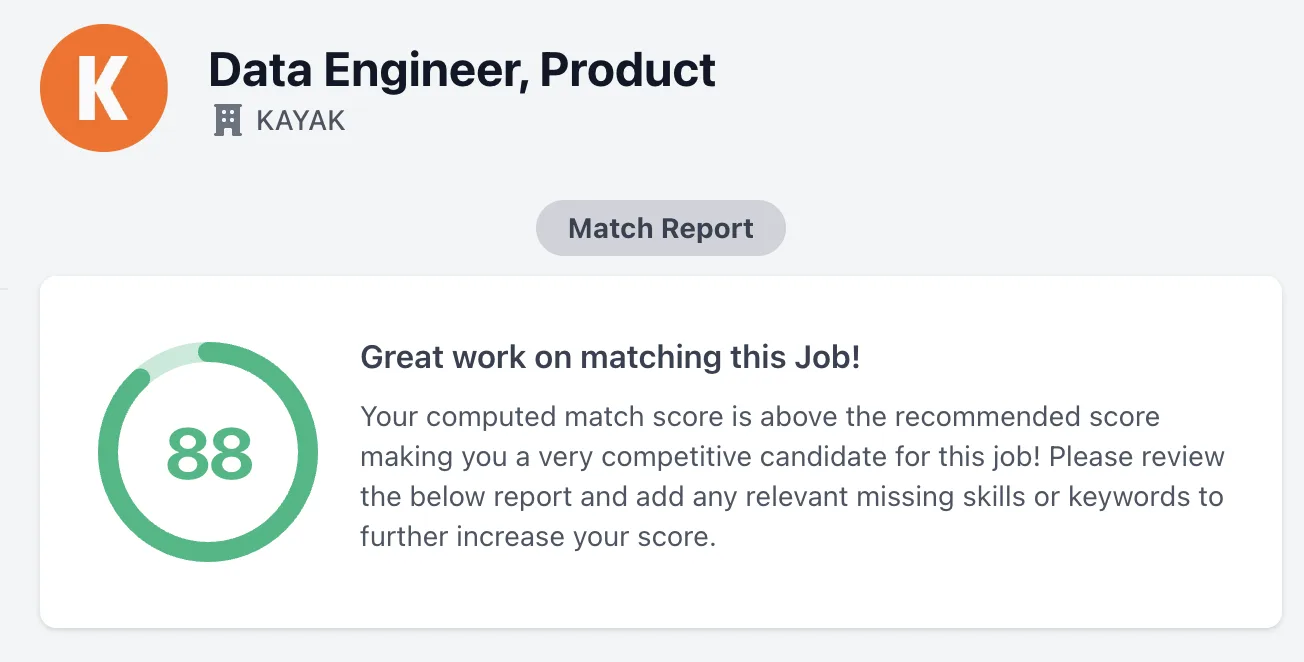
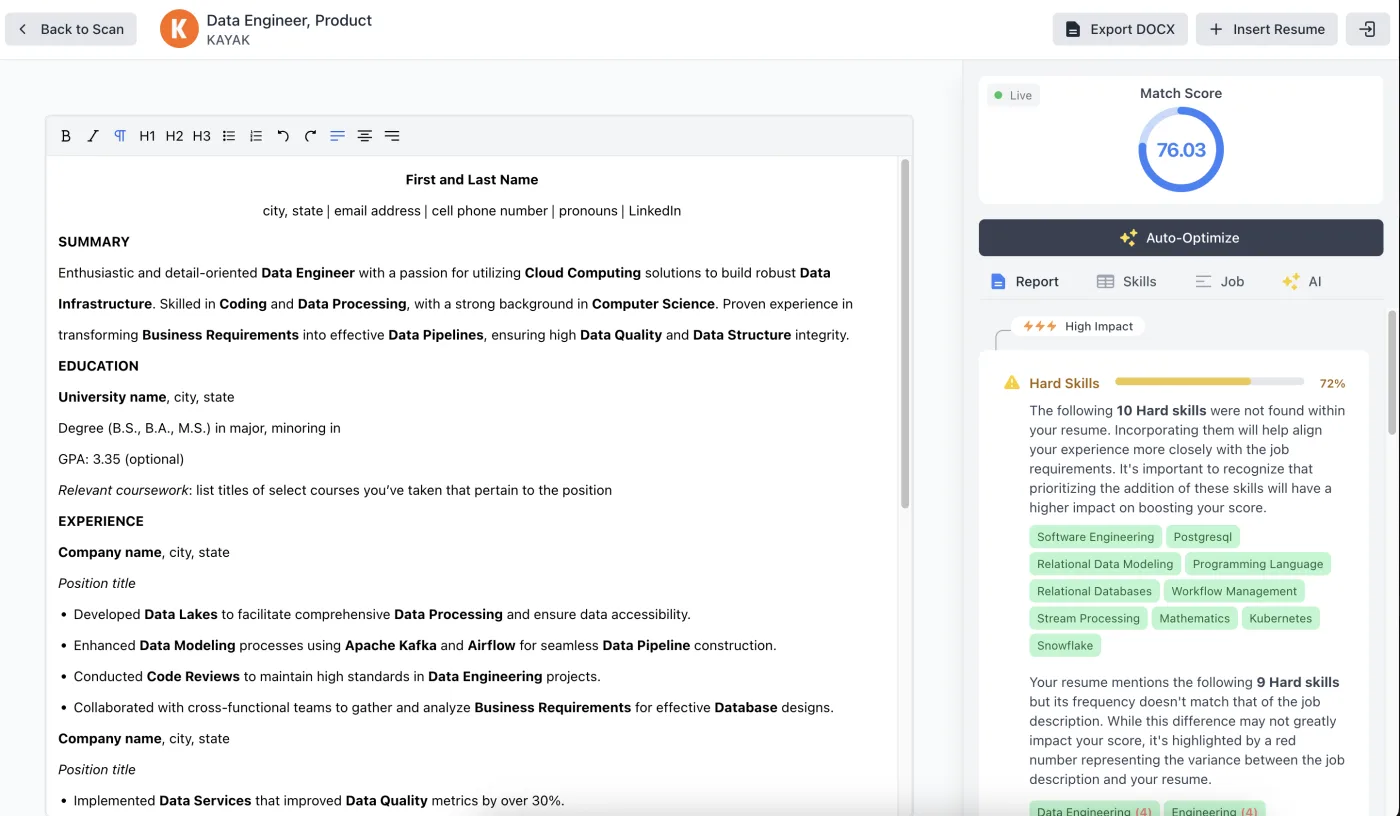
If you are a VP, Director, C-suite executive, or senior leader, you might assume your resume will always reach human hands. It usually does not. Enterprise employers use the same Applicant Tracking Systems as everyone else, and many executive search firms run keyword filters before a recruiter ever opens your file. The difference at the senior level is that the keywords change. Instead of tactical skills, ATS systems at this tier scan for strategic competencies: P&L ownership, board governance, digital transformation, M&A integration, and revenue growth. It is worth taking a minute to check how an ATS reads your resume before you assume seniority exempts you from the filter, and worth knowing what a good resume score actually is at this level.
This guide covers how to write an executive resume that clears those filters while also impressing the human decision-makers on the other side. You will learn how to structure your headline and summary, quantify leadership impact with the right metrics, and avoid the most common mistakes that senior candidates make.
Lead With a Headline That Signals Scope
At the executive level, your headline is not just a job title. It is a positioning statement. Recruiters and headhunters scan hundreds of resumes per search, and your headline determines whether they read further. The strongest executive headlines communicate three things in a single line: your leadership title, the scale of your responsibility, and your primary area of strategic impact.
STRONG EXAMPLE
"Chief Operating Officer | $200M P&L | 15 Years Scaling Global Operations & Leading Digital Transformation"
WEAK EXAMPLE
"Experienced Executive Seeking Senior Leadership Role"
The strong example immediately tells the reader what level you operate at, how large your financial responsibility is, and what strategic capability you bring. The weak example could describe anyone with a few years of management experience. It contains no specifics, no scale, and no differentiation. At the executive level, vague headlines signal a vague candidacy.
Write a Summary That Frames Your Leadership Narrative
Your executive summary should read like a board-ready briefing, not a list of responsibilities. In three to four sentences, establish your career arc, the scale of organizations you have led, and two or three signature achievements that define your leadership brand. This is where you answer the question every hiring committee asks: what will this person do for us?
STRONG EXAMPLE
"Senior operations executive with 18 years of experience scaling B2B technology companies from $50M to $400M in revenue. Led a 1,200-person global organization across 6 countries, driving 32% EBITDA improvement through operational restructuring and digital supply chain transformation. Board advisor with direct experience guiding two successful IPO readiness programs. Seeking a COO or President role in a high-growth SaaS or enterprise technology company."
WEAK EXAMPLE
"Results-driven leader with extensive experience in operations and strategy. Proven ability to lead teams and deliver results in fast-paced environments. Passionate about driving growth and building high-performing organizations."
The strong example uses specific revenue figures, team sizes, geographic scope, and a named strategic outcome (EBITDA improvement). It also mentions board-level experience and names a target role. The weak example is built entirely from generic phrases that could apply to a mid-level manager just as easily as a C-suite executive. At this level, every sentence needs to carry weight.
See How Your Executive Resume Scores
Upload your resume and a leadership job description to see which keywords from the posting are missing from your resume.
Scan My Resume
Quantifying Leadership Impact
The single biggest differentiator between a good executive resume and a great one is how you quantify your impact. At the senior level, hiring committees and search firms expect to see specific metrics that demonstrate the scale and outcome of your leadership. Vague claims about "driving growth" or "improving operations" carry no weight when competing against candidates who cite exact figures.
The CAR Method at the Executive Level
The CAR framework (Challenge, Action, Result) is a well-known structure for resume bullet points, but at the executive level it requires a different emphasis. The challenge should reference a business-critical problem, not a task. The action should describe your strategic decision, not your daily work. And the result must include a financial or operational metric that a board would recognize.
STRONG BULLET POINT
"Inherited a stagnating $120M business unit with declining market share. Redesigned go-to-market strategy and restructured the sales organization from geographic to vertical alignment, resulting in 28% revenue growth and 15% improvement in gross margin within 18 months."
WEAK BULLET POINT
"Managed business unit and implemented new sales strategy to improve revenue and margins."
Metrics That Matter at the Executive Level
Not all numbers carry the same weight on a senior resume. The metrics that executive recruiters and board members look for fall into specific categories:
- Revenue impact: Total revenue managed, revenue growth percentage, new market revenue, ARR or MRR for SaaS companies.
- Cost & profitability: Cost reduction in dollars or percentage, EBITDA improvement, margin expansion, operational savings.
- Team & organizational scope: Total headcount led (direct and matrix), number of countries or regions, departments managed.
- Market & growth metrics: Market share gained, new markets entered, customer acquisition or retention rates, NPS improvement.
- Deal & transaction value: M&A deal size, integration scope, partnership value, capital raised, IPO valuation.
- Transformation outcomes: Digital transformation savings, time-to-market reduction, process automation percentage, technology migration scope.
Framing Your Scope of Responsibility
How you describe your organizational scope matters as much as the results themselves. Be explicit about whether your leadership was global or regional, whether your reports were direct or matrixed, and what the full financial scope of your role included. A hiring committee reading "led a team" pictures something very different from "led a 400-person global organization across 3 business units with $180M in combined revenue and matrix oversight of an additional 200 shared-services staff."
STRONG SCOPE FRAMING
"Directed a 600-person global engineering organization across 4 countries (US, UK, India, Singapore) with full P&L ownership of a $95M annual operating budget and matrix responsibility for 150 cross-functional product and design staff."
WEAK SCOPE FRAMING
"Led a large engineering team responsible for product development across multiple offices."
TIP
If you cannot remember exact figures, use defensible ranges. "Grew revenue from approximately $80M to $130M" is far stronger than "significantly grew revenue." Board members and search committees respect precision. They distrust adjectives like "significant," "substantial," and "major" when used without supporting numbers.
Make Sure Your Resume Matches What Headhunters Search For
SkillSyncer shows you which keywords from each posting are missing from your resume so you can close the gap before you apply.
Try It Free
Key Skills for Executive & Senior Leadership Resumes
These are the strategic competencies and leadership keywords that enterprise ATS systems and executive recruiters most frequently filter for. Include the ones that genuinely reflect your experience and that appear in your target job descriptions.
P&L Management
Strategic Planning
Digital Transformation
Change Management
Board Governance
M&A Integration
Revenue Growth
Organizational Development
Stakeholder Management
Executive Leadership
Cross-Functional Teams
Operational Excellence
Business Development
Talent Acquisition
Enterprise Strategy
Risk Management
Do not paste this entire list into your resume. Each executive role prioritizes different competencies. A CFO search will weight financial keywords differently than a COO search. Scan your resume against each specific job posting with SkillSyncer to see which of these terms that employer is filtering for, then weave in the ones that honestly match your background.
Common Mistakes on Executive Resumes
1. Writing a resume that is too long and unfocused. Many senior leaders feel compelled to document every role they have held over a 20- or 25-year career. The result is a four- or five-page resume where the most impressive recent achievements are buried under pages of early-career history. An executive resume should be two pages, occasionally three for very senior candidates. Focus 80% of your space on the last 10 to 15 years. Earlier roles can be condensed into a single "Prior Experience" section with titles and company names only.
2. Missing quantifiable results on leadership bullet points. At the executive level, every bullet point should include a number. If you led a transformation initiative, state the dollar impact. If you built a team, state the headcount. If you expanded into new markets, name how many and what revenue they generated. Bullet points without metrics read as opinion rather than evidence. Search committees compare candidates side by side, and the executive who quantifies their impact always looks stronger than the one who describes it in adjectives.
3. Letting outdated early-career details take up valuable space. Your first job out of college, your early analyst role, and your initial management positions served their purpose decades ago. They do not belong in a detailed section on an executive resume. Recruiters reviewing senior candidates want to understand your trajectory at the leadership level, not read about an internship from 1998. Condense anything older than 15 years into a brief "Additional Experience" line or remove it entirely.
4. Not including board seats, advisory roles, or speaking engagements. Many senior leaders serve on boards, advise startups, sit on industry panels, or hold nonprofit governance positions. These roles demonstrate influence and strategic thinking beyond your primary employer, and they carry significant weight with search firms. If you hold any board or advisory positions, create a dedicated "Board & Advisory" section near the top of your resume. Omitting these roles is a missed opportunity to differentiate yourself from other candidates at the same title level.