A Resume Score Can Mean Two Different Things
This is why you get contradictory answers when you search for what a good resume score is. The phrase covers two separate measurements, and most tools report one of them without saying which.
How well the resume is written, judged on its own. Is it complete, quantified, free of filler, laid out so a parser can read it? No job posting involved. In SkillSyncer this is your Resume Score.
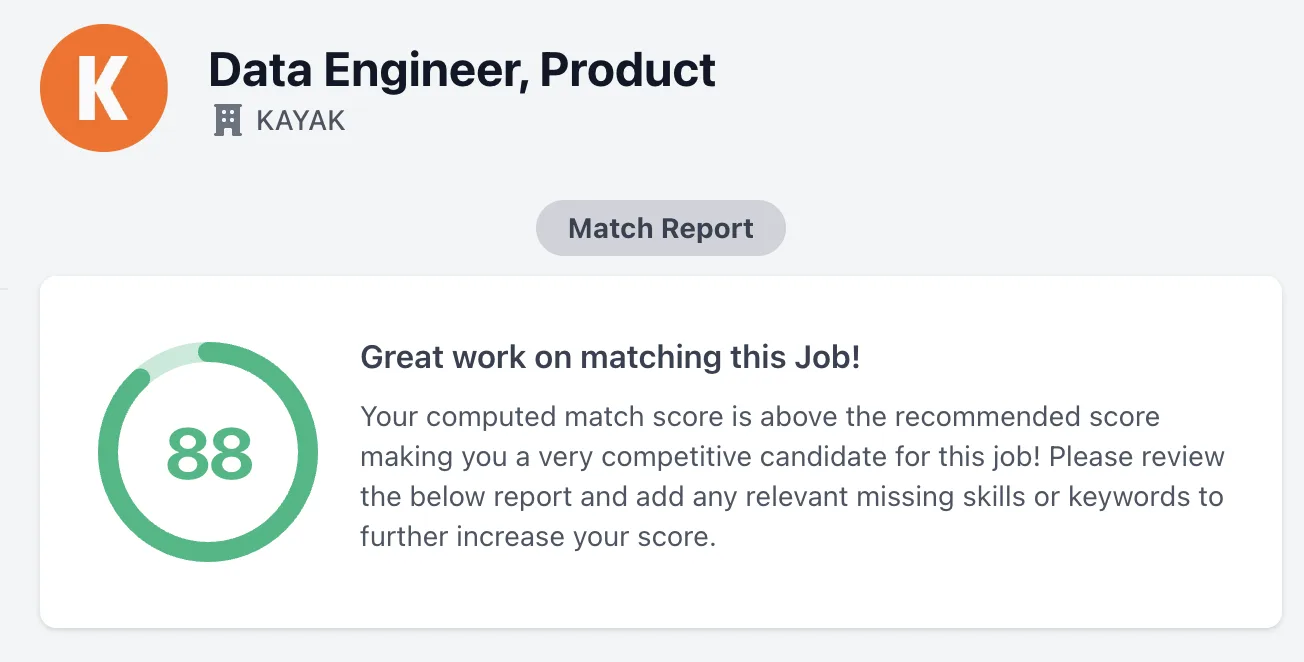
How well it matches a particular job, judged against one posting. Does it contain the skills and terms that employer asked for? In SkillSyncer this is your Match Score.
| Resume Score | Match Score |
|---|
| What it measures | How well the resume is written | How well it fits one posting |
| Needs a job description? | No | Yes, that is the point |
| Does it change per job? | No | Yes, a lot |
| Typical target | 85 or above | 80 or above on that posting |
| Answers | Is this a well-built resume? | Is this the right resume for this job? |
They move independently, which is the part worth internalizing. A resume can be well written, quantified and cleanly formatted, score 92 as a Resume Score, and still match a specific posting at 48 because that employer wants three tools you have never listed. Fixing the second does nothing for the first, and vice versa.
So when someone tells you "aim for 90", ask which number they mean. If a tool gave you a score without asking for a job description, it scored the writing. If it asked for the posting, it scored the match.
What Counts as a Good Score
For a Match Score, aim for 80 or above on the specific job you are applying to. For a Resume Score, 85 or above is the usual bar, and that one you only have to get right once.
| Match Score | What it usually means |
|---|
| 80 to 100 | You have covered what the posting asked for. Further points tend to come from stuffing rather than substance. |
| 60 to 79 | Usually a vocabulary gap, not an experience gap. The posting says "stakeholder management", your resume says "worked with clients". |
| 40 to 59 | Worth reading the missing list before applying. Something substantial in the posting is absent from your resume. |
| Below 40 | Often the wrong role, or a resume the parser could not read properly. Check the formatting before rewriting the content. |
Treat these as working targets rather than thresholds, because no employer publishes one. The number a checker gives you is also not the one an employer sees. Some applicant tracking systems do rank applicants internally, as the next section shows, but they keep that private and none of them publish a pass mark. Your score is a planning tool for you.
Do Applicant Tracking Systems Actually Score Your Resume?
Some do, some do not, and none of them produce the universal "ATS score" the internet talks about. It is worth going to the vendors' own documentation rather than taking anyone's word for it, including ours.
Greenhouse: categories, and it never rejects for you
Greenhouse's Talent Matching sorts applicants into categories: Strong, Good, Partial, Limited, or Needs manual review. The criteria are not Greenhouse's. Before any results appear, the hiring team calibrates it for the job, choosing the skills, experience and job titles that matter and how much each one counts. So the same resume can land in different categories at two employers using the same software.
One detail is worth knowing if you are tempted to pad your skills section. Greenhouse matches related terms on your resume to each calibrated skill, and several terms can map to the same skill, so in its words "a longer list of matched terms doesn't always mean a higher match score."
Its FAQ is also unusually direct about what the categories do not do:
"No. Talent Matching does not auto-reject or auto-advance any candidate, including candidates in lower match categories or those labeled 'Needs manual review.'"
Greenhouse adds that all disposition decisions remain with the hiring team. Read the Talent Matching FAQ.
Workday: a real score, switched on by the employer, and being retired
Workday's Candidate Skills Match does assign a numeric Skills Match Score, and a background process scores every active application on open requisitions. It measures how similar the skills on your application are to the skills on the job requisition, so it is a match score, not a judgment of how well your resume is written. Workday describes it as machine learning recruiters can use to make reviewing applications more efficient, which is a sorting aid, not a filter.
Two caveats matter. It is something each employer turns on, by configuring their tenant to assign the score and to display it on the candidate grid, so it is not present everywhere. And Workday's own documentation now says: "We plan to retire this functionality in a future release." Read the Workday admin guide.
What this means for you
Where scoring exists it is an internal sorting aid for the recruiter, not a gate. It decides what order a human works through a pile. Automatic rejection, where it happens at all, generally comes from knockout application questions you answered, such as work authorization or a minimum years requirement, not from your resume text.
So there is no single number to optimize against. You cannot see the employer's score, it differs by vendor, one major vendor is retiring theirs, and in the systems that do compute one it does not reject you. That is why we call ours a Match Score rather than an ATS score: it measures your resume against the posting, which is a thing we can actually measure, rather than guessing at an employer's private configuration.
Two practical consequences. Be suspicious of any tool whose low score is conveniently fixed by buying its rewrite. And spend your effort on the things every one of these systems genuinely depends on: a file the parser can read, and the words the posting actually uses.
Run the same resume through three checkers and you will get three numbers. That is expected, and it is not a sign that any of them is broken.
Each tool decides for itself what to count and how to weight it. One runs 30 writing checks and never looks at a job posting. Another weighs parse rate heavily, because its thesis is that formatting is where most resumes die. A third scores keyword overlap against the specific posting and ignores writing quality entirely.
The practical rule: compare a score only against itself. A number from one tool before and after an edit tells you whether the edit helped. The same number against a different tool's number tells you nothing at all.
Why One Resume Scores Differently on Every Job
Send one unchanged resume at two postings with the same job title and you can reasonably see 90 on one and 55 on the other.
Two roles called "Marketing Manager" often want genuinely different things. One is asking for paid acquisition, attribution and SQL. The other is asking for brand, content calendars and partner marketing. Both are Marketing Manager. Your resume matches one of them well.
The consequence is that a single resume sent everywhere scores badly almost everywhere. That is the argument for tailoring, and a match score is simply the fastest way to see how much tailoring a given posting actually needs.
What Actually Moves the Number
In rough order of how much difference they make:
| Change | Effect |
|---|
| Adding a hard skill the posting names and you genuinely have | Largest single gain. Hard skills carry the most weight because they are the most specific. |
| Matching the posting's exact phrasing | Significant. "Kubernetes" and "container orchestration" are the same job and different strings. |
| Covering the soft skills named in the posting | Moderate. Worth a pass once the hard skills are covered. |
| Fixing formatting a parser cannot read | Varies, occasionally enormous. If a multi-column layout hides half your experience, nothing else you do counts. |
| Quantifying a bullet that currently states a duty | Moves your Resume Score, not your Match Score. Still the highest-value edit you can make for the human reader. |
| Adding keywords you cannot back up | Raises the number, costs you the interview. Do not. |
That last row matters more than the rest combined. Anything you add has to survive a conversation about it. For the rows above it, one-click optimization makes the additions in a single pass and leaves you to decide what stays.
What Each Score Is Made Of
SkillSyncer reports both numbers, and the Resume Score is itself split in two so you can see which kind of problem you have.
Resume Score: Completion and Content
Your Completion Score asks whether anything is missing. Your Content Score asks how well what is there is written. A resume can be complete and badly written, or beautifully written and missing a phone number, and those need different fixes.
| Completion Score | Content Score |
|---|
| Full name | Quantifiable measurements |
| Email address | Bullet point count |
| Phone number | Bullet point length |
| Location | Paragraph length |
| Headline | Professional summary length |
| Professional summary | Filler words |
| Work experience | Buzzwords |
| Education | Repetitive action verbs |
| Skills | First-person language |
| Weak action verbs |
| Summary has bullet points |
| Experience gap |
Neither half needs a job posting. Get your Resume Score right once and it stays right, whatever you apply to next. Both halves are scored as you write if you build the document in the resume builder.
Match Score: against one posting
The Match Score weighs your resume against a specific job across hard skills, soft skills and other relevant terms, with hard skills weighted heaviest. A posting naming a specific tool is telling you something more precise than one asking for a self-starter.
Alongside the number you get the list behind it: which terms the posting asked for, which your resume already contains, and which are missing, sorted so the ones worth the most sit at the top. That list is what the keyword scanner produces. The list is the useful part. The number is just its summary.
Formatting an applicant tracking system is likely to trip on is a separate question again, covered by the ATS resume checker.
How to Check Your Resume Score
Upload your resume, paste the job description you are actually applying to, and you get the match score plus the list of missing terms. A free account includes two scans a week, and no credit card. If you want the longer walkthrough first, scanning a resume step by step covers it.
One habit worth forming: score against a real posting, never a generic one. A score against a job you invented tells you nothing, because the thing being measured is the fit to a specific employer's ask.
A few seconds, a resume and one posting. You get the match score and every term the job asked for that your resume does not contain.
Check My Resume Score